
Sade Traditional Village Fire: When the Flames Destroyed More Than Houses, But Also Part of Sasak Cultural Life
These are that You Should Know
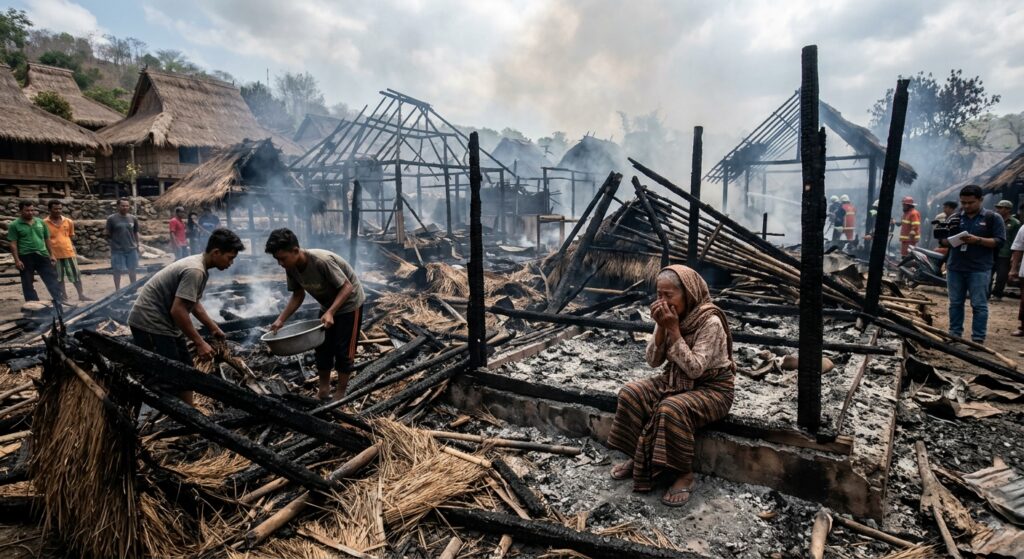
LOMBOK, Lombokpedia.id – Saturday night, August 22, 2026, became one of the darkest nights in the history of Sade Traditional Village in Pujut District, Central Lombok. Flames swept through the traditional settlement, known around the world as one of the most important representations of Sasak culture in Lombok. Within hours, rows of traditional houses with thatched roofs, bamboo walls and wooden structures were reduced to blackened ruins, leaving behind grief for the local community.
The incident quickly attracted national and international attention. Reuters documented the post-fire situation through aerial photographs, while ANTARA and several Indonesian media outlets reported on the government’s efforts to assist affected residents, inventory cultural objects and prepare a recovery plan for the traditional settlement. For the people of Lombok, this was not simply a residential fire. It was the loss of part of a living cultural space that had been passed down through generations.
What Actually Happened?
According to reports from various media outlets, the fire broke out on the night of Saturday, August 22, 2026, in Sade Traditional Village, located in Rembitan Village, Pujut District, Central Lombok. The fire spread rapidly because many of the traditional buildings were constructed from natural materials such as wood, bamboo and thatch, which can burn quickly once exposed to a large fire.
However, as of Monday, August 24, 2026, the exact cause of the fire had not yet been officially determined. West Nusa Tenggara Governor Lalu Muhamad Iqbal said that preliminary indications pointed to an electrical issue, but emphasized that the cause was still under investigation and could not yet be considered a final conclusion. This distinction is important because various unverified theories had already begun circulating on social media.
Important fact: The number of affected houses was still being updated
Different media reports published different figures, including 120 houses, 129 houses, and another report mentioning 89 houses completely destroyed and approximately 30 heavily damaged buildings. These differences do not necessarily mean that one report was wrong, but rather reflect the fact that damage assessments were still being conducted during the first days following the disaster.
For journalistic purposes, it is therefore safer to use wording such as “more than 100 traditional houses were reportedly affected” or “around 120 houses, according to initial media reports,” while clearly identifying the source.
No fatalities had been reported in the coverage available at the time. Following the fire, the government’s immediate focus was on ensuring basic needs, healthcare services, children’s education and the recovery of residents who had lost their homes and belongings.
The Central Lombok Government also stated that it would provide assistance and support the reconstruction of the area while maintaining the traditional values that make Sade culturally distinctive.
Why Has the Fire Attracted International Attention?
For many foreign tourists, Sade is associated with traditional thatched-roof houses and Sasak women sitting on verandas weaving colorful fabrics. That image is indeed part of Sade, but it does not tell the whole story.
Sade is not an open-air museum. The houses inside the settlement are real homes occupied by members of the Sasak community. Families live there, cook there, raise children there, weave there and carry out their daily lives alongside tourism activities.
This is what makes the fire much more significant than the loss of physical buildings. When a traditional house burns, what disappears is not simply bamboo or thatch. It can also mean the loss of a family space, a place for weaving, a place where cultural objects are stored, a space for family rituals and a part of the collective memory of the Sasak people.
The West Nusa Tenggara Cultural Office has also begun inventorying cultural artifacts affected by the fire. This is important because the value of a traditional village is not contained solely in its architecture, but also in the objects, crafts, traditions and memories preserved within the community.
Five Things International Visitors Should Know About Sade
1. Sade is a living village, not a museum
Many tourists arrive with the assumption that Sade is some kind of cultural park or traditional museum. In reality, Sasak families genuinely live there, raise their children, cook, weave and practice their traditions as part of everyday life.
For international visitors, this means Sade should be treated as a residential community rather than simply a photography destination. Visitors should respect the privacy, routines and cultural practices of local residents.
2. Weaving is more than a souvenir
One of the most famous experiences in Sade is watching Sasak women manually weave traditional fabrics. Weaving is passed down through generations and is an important part of Sasak women’s cultural identity.
For foreign visitors, buying traditional textiles directly from local artisans is therefore more than simply purchasing a souvenir. It can also help support the livelihoods of families who continue to preserve this tradition.
3. Traditional materials are both beautiful and vulnerable
Sade’s traditional houses are built using natural materials such as bamboo, wood and thatch. These materials give the village its distinctive visual character, but they also create significant challenges when fire breaks out because flames can spread rapidly.
The Central Lombok Government has indicated that the recovery of Sade must consider improved emergency access and disaster response while maintaining the traditional architecture and cultural values of the village.
4. Respect the privacy of the local community
Because Sade is an inhabited village, visitors should not enter houses without permission, photograph residents without consent or treat everyday activities as entertainment.
The best approach is to follow the guidance of local guides, interact respectfully with residents and ask permission before photographing individuals, particularly women who are weaving and children who are playing.
5. Buying directly from local artisans matters
Cultural tourism in Sade has traditionally depended on direct interaction between visitors and the local community. Buying woven fabrics, accessories and handicrafts directly from local artisans can support family livelihoods while giving economic value to cultural preservation.
Following the fire, supporting the local economy is even more important because many families have lost homes as well as spaces where they produced and sold traditional crafts.
Not All of Sade Has Disappeared
One narrative circulating on social media has been that “Sade Village has been completely destroyed by fire.” This needs to be clarified so that international visitors do not misunderstand the situation.
The fire affected a large part of the traditional residential area, while the process of identifying damaged houses, cultural objects, surviving structures and other affected areas is still ongoing. The Central Lombok Government has emphasized that the recovery process will preserve the historical and cultural character of Sade rather than replace it with modern structures that would erase its identity.
In other words, what is being restored is not merely a collection of buildings. What is being protected is the continuity of Sasak community life so that the traditions that have made Lombok known around the world can continue to be passed down to future generations.
A Brief Timeline of the Fire
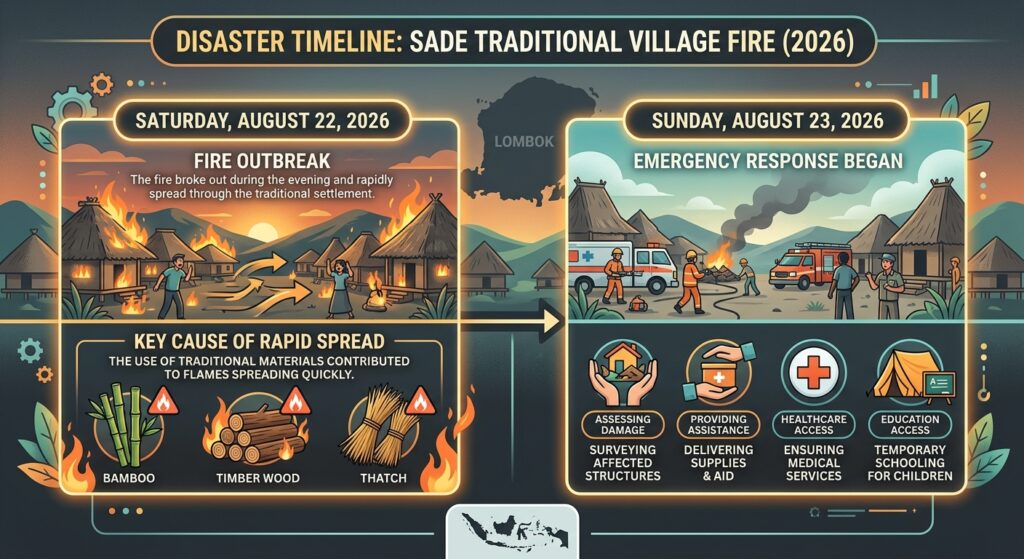
Saturday, August 22, 2026
The fire broke out in Sade Traditional Village during the evening and rapidly spread through the traditional settlement.
The fire spread rapidly
The use of bamboo, wood and thatch in many traditional structures contributed to the rapid spread of the flames across the settlement.
Sunday, August 23, 2026
Local authorities began responding to the disaster, assessing the damage, providing assistance and ensuring access to healthcare and education for affected residents.
The next stage
Authorities began investigating the cause of the fire, inventorying cultural artifacts and preparing plans to reorganize and rebuild the affected traditional area while maintaining its Sasak cultural identity.
What Is the Government Doing?
The Central Lombok Government has stated that the response will not stop with emergency assistance. The next stage will focus on rebuilding the Sade area while considering three important elements at the same time: community safety, emergency access and preservation of traditional values.
The government has also described the disaster as an opportunity to make the traditional settlement more resilient to future emergencies without sacrificing its distinctive architecture and cultural identity.
At the provincial level, the West Nusa Tenggara Cultural Office has begun documenting cultural artifacts and objects affected by the fire. This step is important because the value of a traditional village is not limited to its physical buildings. Traditional objects, crafts, tools, family belongings and cultural memories are also part of its heritage.
Meanwhile, local authorities have emphasized that the needs of affected residents remain a priority, including healthcare, education for children and social assistance during the recovery period.
This means that the Sade fire is being treated not only as a physical disaster, but also as a humanitarian issue affecting the continuity of an indigenous community’s way of life.
Why Should International Tourists Understand This Context?
Many cultural destinations around the world have eventually become staged attractions. Sade is different because its cultural appeal comes largely from the fact that Sasak traditions are still practiced as part of everyday life.
When tourists visit Sade, they are entering a community rather than a cultural theme park. That makes respect one of the most important parts of the visitor experience: respecting residents, following local rules, asking permission before taking photographs and understanding that every house has a social and family function for the people who live there.
The August 22, 2026 fire also offers an important lesson for the global tourism industry. Cultural destinations are not simply beautiful buildings to photograph. They are living ecosystems that can be extremely vulnerable.
When a traditional house burns, the consequences can extend to housing, family livelihoods, weaving activities, tourism, children’s education and the survival of cultural traditions themselves.
For that reason, the most appropriate message for international visitors is not that “Sade has disappeared,” but that “Sade is rebuilding.”
The local community, government and other stakeholders are now working to restore the area while protecting Sasak cultural values so that Sade remains a living part of Lombok rather than becoming merely a memory in the travel albums of visitors from around the world.
Use the right terminology
It is more accurate to describe Sade as a “traditional village” or a “living traditional village,” rather than simply a “cultural attraction.” These terms better reflect the fact that people still live there and practice their traditions.
Do not speculate about the cause of the fire
The official cause was still under investigation at the time of reporting. The electrical issue mentioned by the governor was a preliminary indication, not a final conclusion.
The damage figures may continue to change
Different media outlets have reported different numbers because assessments were still underway. In international reporting, it is safer to say “more than one hundred traditional houses were reportedly affected in initial reports,” while identifying the source.
Support the local economy
When the area is ready to receive visitors normally again, purchasing traditional textiles and handicrafts directly from local artisans can provide more meaningful support than buying products from outside the community.
For people outside Lombok, the Sade fire may initially appear to be a story about flames destroying traditional houses. For the Sasak community, however, the meaning is much deeper.
What has been affected is the living space of a community, a place where traditions are passed from one generation to another, where Sasak women preserve weaving traditions, where families raise children and where one of Lombok’s most recognizable cultural identities has been kept alive.
Sade reminds us that cultural heritage is never made only of bamboo, wood and thatch. Cultural heritage lives in the people who inhabit it.
As long as the Sasak community continues to preserve its language, weaving, houses, traditions and ancestral values, there is always hope for Sade to rise again from the ashes left by the fire.
(From some of sources)